

This article was written and reviewed by Serge, MSc. I hold degrees in Plant Biology, Environmental Biology and Biogeochemistry, with research experience in plant physiology, ecosystem science, and field-based environmental studies. Every article on this site is grounded in real academic training and genuine scientific research.
Affiliate disclosure: This site has affiliate links, including Amazon. As an Amazon Associate I earn from qualifying purchases, at no extra cost to you.
If there is one herb I always recommend to people who think they kill everything they grow, it is thyme.
It asks for very little. Sun, sharp drainage, and occasional harvesting. That is genuinely it. And yet I see people struggle with it all the time, usually because they are treating it like a moisture-loving herb when it is actually the opposite.
My background is in plant biology and plant biochemistry, and a significant part of my postgraduate research involved studying how plants respond to environmental stress conditions in the field.
One thing that research reinforced repeatedly is that many plants, thyme included, are not just tolerant of difficult conditions. They actually perform better under them. Understanding that principle changes how you approach growing thyme completely.
So What Exactly Is Thyme?
Thyme (Thymus vulgaris) is a perennial evergreen herb belonging to the Lamiaceae family, the same family as mint, rosemary, and basil. It originates from the Mediterranean region where it grows wild on dry, rocky slopes with thin soil, strong sun, and very little rainfall.
That natural habitat tells you almost everything you need to know about growing it successfully.
The plant is a perennial, meaning it returns year after year without replanting. One good plant, positioned correctly, can produce harvests for a decade. That is exceptional value for minimal effort.
The characteristic flavour comes from volatile compounds called thymol and carvacrol. These are secondary metabolites, chemical compounds the plant produces primarily as a defence against insects and pathogens rather than for our benefit in the kitchen.
From my plant biochemistry studies I know these compounds accumulate in higher concentrations when the plant experiences mild stress, dry soil, lean nutrient conditions, and high light intensity. This is why thyme grown hard, in poor dry soil with full sun, consistently tastes stronger than thyme grown in rich, moist, heavily fed conditions. The plant’s stress response works in your favour.
Picking Your Variety
The thyme family is large but for home growing these are the varieties worth knowing:
Common thyme (Thymus vulgaris), the go-to culinary variety, robust flavour, easy to find anywhere
Lemon thyme (Thymus citriodorus), a bright citrus note that works beautifully with fish, chicken, and salads
Creeping thyme (Thymus serpyllum), spreads low and wide, perfect for gaps between paving or as a fragrant ground cover
French thyme, a more refined culinary variety with a slightly softer flavour, popular in classic cooking
Start with common thyme for cooking. Add lemon thyme once you get the hang of it. Use creeping thyme anywhere you want low-maintenance ground cover with a sensory bonus.
Getting the Growing Conditions Right
Thyme does not forgive two things: shade and wet roots. Get these right and everything else is straightforward.
Sun:
Six hours of direct sunlight minimum, every single day. Thyme evolved under intense Mediterranean sun and its physiology reflects that. In lower light conditions the plant becomes leggy, produces fewer leaves, and the volatile oil content drops noticeably. You will taste the difference.
Soil and drainage:
Free-draining soil is non-negotiable. Thyme roots sitting in moisture develop root rot fast. If your garden soil holds water, grow thyme in a raised bed with added horticultural grit, or simply use containers where you control the drainage. Soil pH between 6.0 and 8.0 works well. Thyme tolerates slightly alkaline conditions better than most herbs, making it ideal for chalky or limestone gardens.
Outdoors versus indoors:
Outdoors is always my first recommendation. A sunny border or raised bed gives thyme exactly what it evolved for. Indoors is possible but demands your brightest window, ideally south-facing, with supplemental grow lighting in winter. Terracotta pots work best indoors because they breathe and help excess moisture escape from the root zone.
Planting Thyme
From cuttings:
Take a healthy stem around 8 to 10 cm long, strip the lower leaves cleanly, and place either in gritty compost or a glass of water on a bright windowsill. Roots appear within two to three weeks in water. Transfer to soil once they reach 2 cm. This is faster and more reliable than seed every time.
From seed:
Germination takes two to three weeks and seedlings are slow to develop. If you go this route, start indoors six to eight weeks before the last frost. Cuttings are always the better option if you can get them.
From a bought plant:
Choose something compact and bushy. Leggy plants with pale or yellowing leaves have already been stressed by poor conditions in the shop and take longer to establish. Spacing at 20 to 30 cm gives each plant room to develop its natural shape.
Watering. The Most Common Mistake
Water established thyme less than you think you need to.
Once settled in, outdoor thyme in a temperate climate barely needs supplemental watering at all. Rainfall handles it. Indoor thyme needs more attention but still far less than most herbs. Check the top 2 cm of soil and water only when it is completely dry.
Overwatered thyme shows yellowing leaves and soft, mushy stems at the base. Root rot sets in quickly under these conditions. Once it is established always underwater rather than overwater. Thyme handles dry spells far better than it handles wet roots.
Pruning and Harvesting
Regular harvesting is effectively the same as pruning with thyme, and it keeps the plant productive, compact, and full of fresh growth.
Cut stems from the tips, always snipping just above a leaf node. This triggers branching and increases your harvest points over time. Take no more than one third of the plant at a single session.
The best time to harvest is just before flowering when volatile oil levels peak, and in the morning once any surface moisture has dried. The flavour at this point is noticeably stronger than at other times.
After flowering prune the plant back by around one third. This prevents the plant becoming too woody too fast. Never cut into the old woody base, thyme does not regenerate from bare wood.
Dried thyme keeps its flavour remarkably well compared to most herbs. Hang bunches upside down in a warm airy spot or freeze sprigs directly.
Should You Let Thyme Flower?
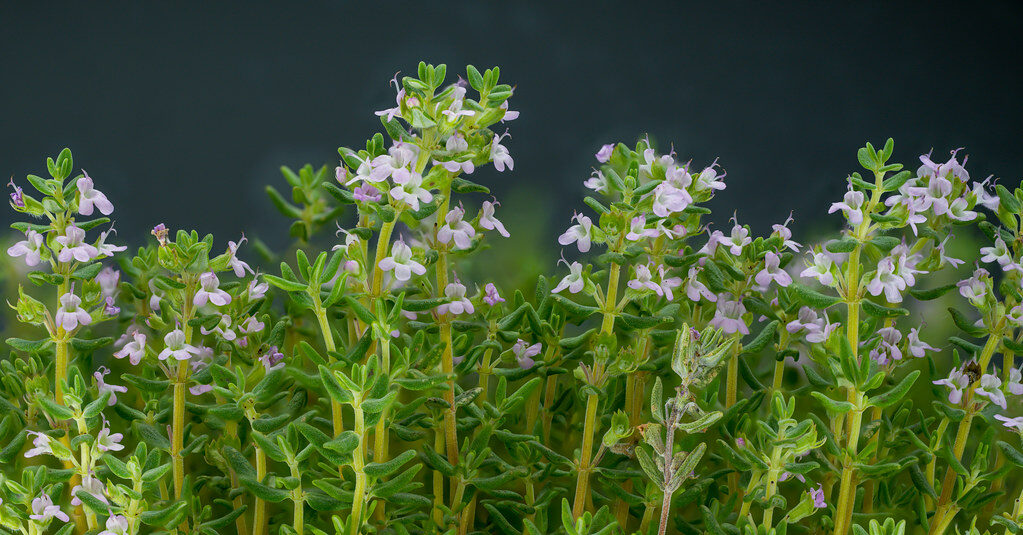
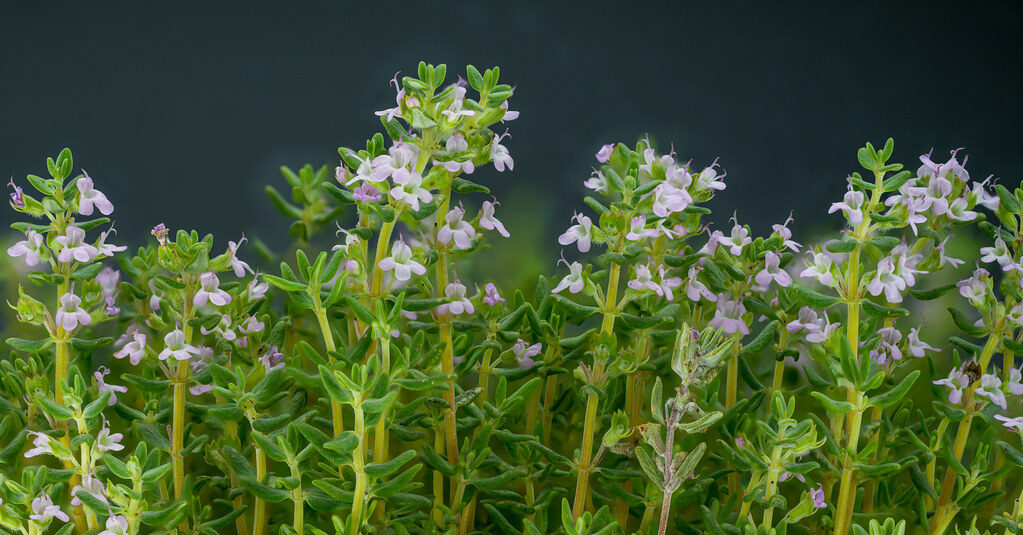
Yes, for a while. The flowers are small and beautiful, ranging from pale pink to purple depending on variety, and pollinators absolutely love them. They are also edible with a milder version of the leaf flavour.
Once the flowering period finishes, prune back. Leaving dead flower heads on the plant accelerates the woody growth that reduces leaf production over time.
Troubleshooting
Plant turning brown or dying: Check drainage and watering first in almost every case. Soft mushy stems at the base point to root rot from overwatering. Brown tips after winter are normal and recovery usually happens in spring without intervention.
Yellow leaves: Overwatering or waterlogged soil. Occasionally a nutrient deficiency but drainage is the first thing to check and fix.
Weak leggy growth: A light problem. More sun, or a grow light indoors, combined with a prune back will transform the plant within a few weeks.
Woody plant with few leaves: Insufficient pruning over time. Take cuttings from any healthy growth and start fresh alongside regular pruning of the existing plant.
Frequently Asked Questions
Is thyme a perennial?
Yes. Thyme is a hardy perennial that returns each year without replanting. In mild climates it stays evergreen year-round. In colder regions it may die back in winter but reliably pushes new growth in spring.
Can thyme grow indoors?
It can, but light is the limiting factor. South-facing windows with at least 6 hours of brightness are the minimum. Many indoor positions fall short of this, making a grow light a practical necessity for consistent indoor thyme growing.
Will thyme grow back after winter?
Yes in most climates. The root system overwinters well and sends up new growth each spring. In regions with very harsh prolonged winters, container plants brought indoors before hard frosts give the most reliable results.
Can thyme survive frost?
Common thyme handles frost well, tolerating down to around -15°C in free-draining soil. Wet soil combined with frost is far more damaging than dry frost alone. Good drainage is the key factor in winter survival.
Should thyme be cut back in spring?
Yes. A light prune after flowering removes around one third of the new growth, keeps the plant compact, and encourages fresh productive stems for the season ahead. Avoid cutting into old woody growth at the base.
Are thyme stems edible?
Young green flexible stems are fine to eat and cook with. The older woody stems at the base of the plant are too tough but work well in stocks and slow-cooked dishes where they can be removed before serving.
Are thyme flowers edible?
Yes, completely. They have a softer, slightly floral version of the leaf flavour and work well as a garnish on salads, soups, and meat dishes. They are also a valuable nectar source for bees and other pollinators.
Can thyme and rosemary be planted together?
Yes, they are natural companions. Both share almost identical growing requirements, full sun, well-drained soil, lean conditions, and minimal watering. They work beautifully together in any herb garden or container planting.
Can thyme be planted with tomatoes?
Yes. The volatile compounds that give thyme its aroma also deter several common garden pests. Planting thyme alongside tomatoes in a raised bed is a simple and effective companion planting combination.
Which thyme is best for cooking?
Common thyme (Thymus vulgaris) for everyday use. Lemon thyme for fish, chicken, and lighter dishes. French thyme for classic cuisine. All three are genuinely useful and worth growing if you have the space.
Which thyme is best for ground cover?
Creeping thyme (Thymus serpyllum). It spreads low and gradually, fills gaps between paving beautifully, produces attractive flowers, and releases fragrance when walked on. Very little maintenance required once established.
Will thyme root in water?
Yes. Strip the lower leaves from a healthy cutting, place in a glass of water on a bright windowsill, and roots appear within two to three weeks. Change the water every few days and transfer to soil once roots reach 2 cm.