
This article was analyzed by Serge, MSc. Leveraging a background in Botany, Plant Physiology, and Biogeochemistry, I provide evidence-based insights into plant health, soil science, and sustainable cultivation. My focus is on delivering scientifically accurate data to help you grow with confidence.

I’ve seen it many times. You walk into your grow space, expecting vibrant green leaves, and instead, your plants look like they’ve spent a week in a dehydrator, yellowing, burnt edges, and just… sad.
You check your reservoir, and the meter shows plenty of nutrients. Everything should be fine, right? But here’s the catch: your plants can’t actually absorb those nutrients. In the industry, we call this Nutrient Lockout when the food is there, but the plant’s “doors” are jammed, and it can’t eat.
Most people think lockout means the food is missing. They assume the plant is hungry, so they dump more fertilizer into the tank.
But as a scientist, I look at it differently: the food is usually right there, but the “door” to the plant is jammed shut. Adding more food to a jammed door just makes the pileup worse.
To fix this, we have to understand Ion Antagonism. It sounds like a big academic term, but it’s really just a microscopic traffic jam that happens because of basic physics.
The “Jammed Door” Theory
Think of your plant’s roots like a high-security building. This building has thousands of tiny, specialized doors. One door is strictly for Calcium, one is for Magnesium, another for Potassium, and so on.
Many of these nutrients carry similar electrical charges. If you have a massive amount of Potassium floating around in your water, those Potassium ions “crowd” all the doors. Even if there’s plenty of Magnesium right next to them, the Magnesium can’t get in because the Potassium is physically blocking the entrance.
It’s like a game of musical chairs where one nutrient has taken all the seats, and the others are left standing outside.
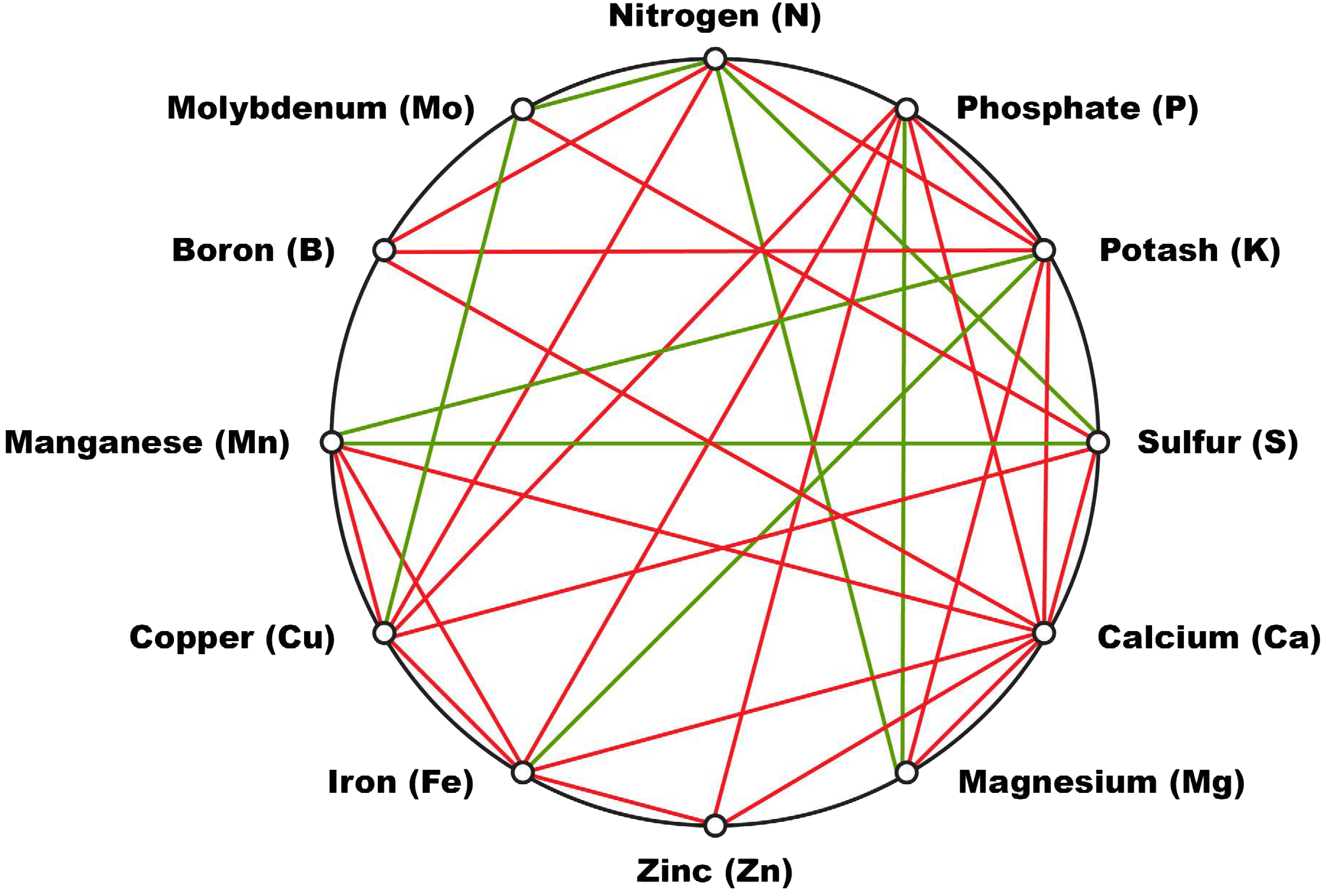
In my biogeochemistry work, I rely on Mulder’s Chart. It looks like a messy web of arrows, but it’s actually a map of which nutrients “fight” each other. If you understand these rivalries, you can stop guessing and start growing.
The Big Rivalries: Who is Fighting Whom?
To keep your system from crashing, you need to watch out for three specific “fights.” These happen in almost every home setup eventually.
1- The Cation Clash (K, Ca, Mg)
A common mistake is adding a bloom booster to increase flowers or fruit. These products are usually high in potassium (K).
Adding too much potassium can interfere with the plant’s uptake of calcium (Ca) and magnesium (Mg). Even if your reservoir contains sufficient calcium and magnesium, the plant may not be able to absorb them.
This often causes tip burn or yellowing between leaf veins. The problem is not a deficiency in the solution, it’s that the plant cannot access the nutrients due to the excess potassium.
2- The Nitrogen Trap
Nitrogen is the gas pedal. It makes things green and fast. But if you use too much of certain types of Nitrogen, it can actually stop your plant from absorbing Potassium. You’ll know this is happening if your plants look dark green and beautiful, but the stems feel like wet noodles.
The Nitrogen is telling the plant to grow leaves, but the “Nitrogen Trap” is preventing the Potassium from building the actual structure of the plant.
3- The Phosphorus Block
When phosphorus levels get too high, it doesn’t just stay in the water. It reacts with trace minerals like iron and zinc, causing them to form solid particles instead of staying dissolved. If you look at the bottom of your tank and see a fine layer of grit or sand, that’s your nutrients settling out of the solution.
Your plant can’t absorb these solids, so the top leaves start turning pale yellow from an iron deficiency.
Why Your Meter Might Be Misleading
Many growers rely heavily on their EC (Electrical Conductivity) meter. While it is a useful tool, it has a major limitation.
The meter measures how well electricity flows through the water, showing the total concentration of dissolved ions, but it cannot identify which nutrients are present. Some ions may be absorbed by the plant, while others are not.
If you keep topping off your tank with nutrients over time, the EC reading may remain “normal,” but the water can accumulate ions that the plant cannot use. This is known as “Ghost EC.”
Ghost EC is a common reason hydroponic systems fail after a few weeks without a full water change: the meter indicates the plants are fed, but many nutrients are inaccessible.
pH: The Critical Factor
pH determines whether your plants can absorb nutrients. If the pH is outside the correct range, nutrients may become unavailable or toxic.
-High pH (above 7.0): Water is too alkaline. Nutrients such as iron can precipitate and become insoluble, making them unavailable to the plant.
-Low pH (below 5.0): Water is too acidic. Some minerals, like manganese, become too concentrated, which can damage plant cells.
The optimal pH range is 5.5 to 6.2. Within this range, all essential nutrients remain available. If your pH is outside this range, much of the fertilizer you add will be wasted.
How to Fix It
If your plants are struggling, don’t just add more “Cal-Mag.” You’ll just make the “crowd” at the door even worse. You need a clean reboot.
Here’s how I do it in the lab when a solution gets messy.
-
Drain the Tank: Don’t try to “fix” the water that’s already in there. You have no idea what the ratio of nutrients is at this point. Drain the reservoir completely and start over.
-
The Fresh Water Flush: Fill the system with plain, pH-balanced water (around 5.8). If you have an RO (Reverse Osmosis) filter, use it. Let the system run for 24 hours with just this water. This acts like a “detox.” It rinses the excess salts off the roots and uses osmotic pressure to pull the “clog” out of the plant’s system.
-
Mix a New Batch (Half Strength): Start fresh with a balanced nutrient profile. But here’s the trick: start at half-strength. Your plant is stressed out. Giving it a heavy meal right now will just shock it.
-
Watch the New Leaves: Leaves that are already burnt aren’t going to turn green again. Look at the new growth at the top. If the new leaves are vibrant and green, you’ve unlocked the doors.
The “Topping Off” Trap
One of the hardest habits to break is topping off your reservoir with more nutrients whenever the water level drops.
Here’s what’s really happening: your plant “sweats” water through its leaves to stay cool. In a hot grow tent, it might drink 5 liters of water a day, but it only takes in a tiny fraction of the salts you added. If you add more nutrients to replace the lost water, you’re actually doubling the salt concentration in the tank. This is one of the fastest ways to trigger a nutrient lockout.
My rule: always top off with plain water. Only add more nutrients when your EC reading truly drops.
Your Tap Water is Probably Part of the Problem
If you’re using tap water, your plant’s roots are already starting with a “pre-crowded” doorway. Most city water is “hard,” meaning it contains a lot of calcium carbonate. The problem is your nutrient formula doesn’t know what’s in your tap water. If the mix is balanced for pure water but your tap already has 200 ppm of calcium, you’ve thrown off the ratios before you even start.
Using a reverse osmosis (RO) filter is like starting with a clean lab bench, you get to decide exactly which nutrients get a seat at the table. If you can’t use an RO filter, at least let your tap water sit out for 24 hours to remove the chlorine before adding nutrients.
Common Questions
Can I use my hydro nutrients in a soil garden?
Yes, but you need to be careful. Hydroponic nutrients are chelated, which means they’re designed to be absorbed immediately. Soil, on the other hand, acts like a giant sponge. If you use the full hydro dose in soil, salts can build up quickly and actually draw moisture away from the roots. A good rule of thumb: cut the dose by 50% when switching to soil.
Why does my pH keep going up every day?
This is actually a good sign! It means your plants are taking in nitrogen. When a plant absorbs a nitrogen ion, it releases a tiny alkaline byproduct to maintain internal balance. This shows the plant’s metabolism is active. Simply adjust the pH back down once a day and continue monitoring.
How do I know if it’s a real deficiency or just a lockout?
Think about your recent actions: Have you added “boosters”? Topped off the reservoir? Changed your water recently? If so, it’s 99% likely a lockout rather than a true deficiency. Real deficiencies are rare if you’re using a quality base nutrient, most problems come from adding too much of the wrong thing.
Summary
Hydroponics gives you full control, but mistakes can quickly harm your plants. They do not need extra nutrients; they need access to the nutrients already in the system. Maintain proper pH, perform regular water changes, and avoid adding too many boosters. Following these steps will keep your plants healthy.
